Pudgy Penguins and the NFT Brand That Built a Toy Empire Before Its Token
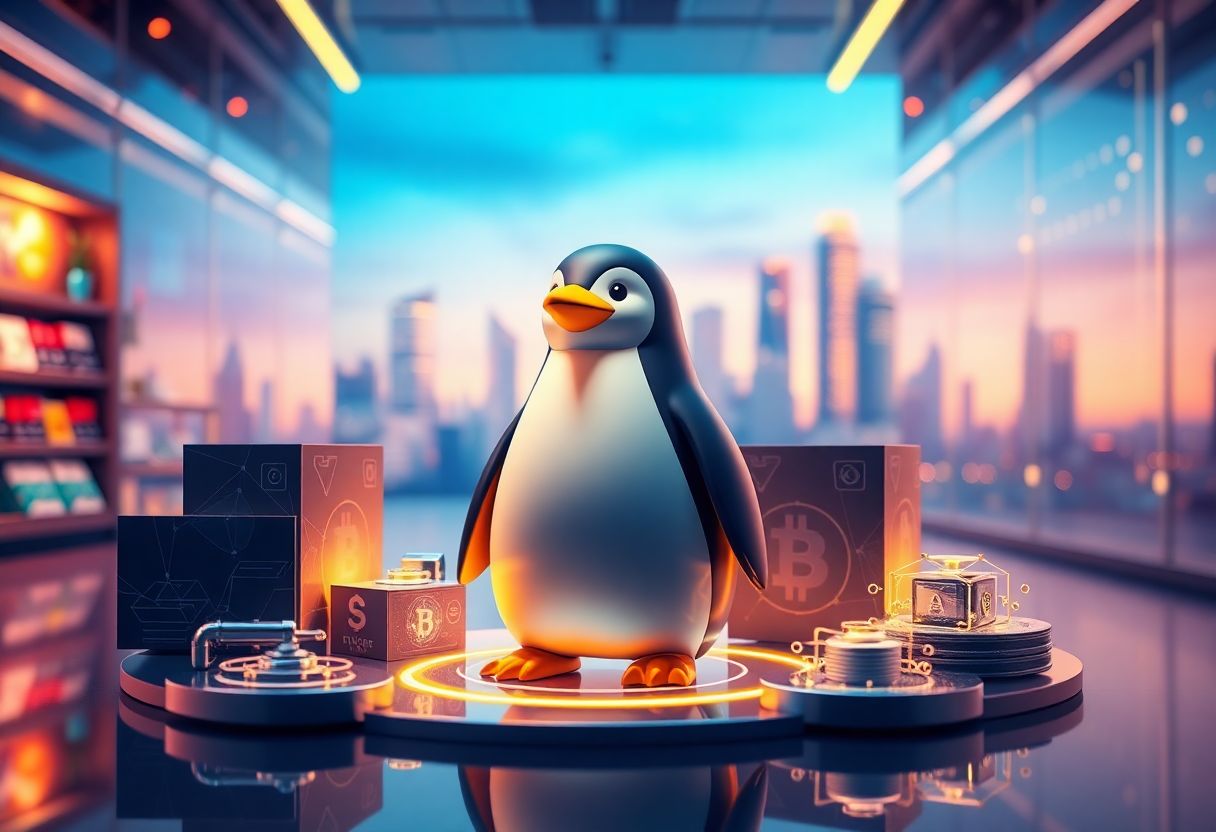
Pudgy Penguins (PENGU) sits at a market capitalization rank of 89 as of May 8, making it one of a handful of NFT-originated projects that successfully converted community goodwill into a diversified consumer brand. The collection’s parent entity has placed Pudgy Penguins plush toys on Walmart shelves and launched its own blockchain.
The question for 2026 is whether a toy brand and a token are enough to sustain long-term relevance in a market where hundreds of NFT collections have gone to zero.
The Walmart Moment That Changed Everything
Pudgy Penguins appeared in Walmart stores in late 2023, a deployment that surprised the NFT industry. Physical toys tied to NFT IP had been tried by other projects without meaningful retail traction.
Pudgy Penguins achieved national distribution, reportedly selling through initial stock allocations at select Walmart locations within weeks.
The toy line connects physical ownership to a digital identity layer. Each toy ships with a code that unlocks a corresponding digital collectible, a mechanic designed to introduce Walmart shoppers to NFT concepts without requiring them to own a crypto wallet at the point of purchase.
Pudgy Penguins CEO Luca Netz has described the brand strategy as meeting consumers where they are rather than requiring them to migrate into crypto-native platforms first.
That philosophy separates Pudgy Penguins from most NFT projects that launched tokens as a primary value proposition and left physical merchandise as an afterthought.
Also Read: LAB Token and the AI Data Economy Behind Its $465M Market Cap
Abstract: Building a Home Chain
In early 2025, Pudgy Penguins launched Abstract, a Layer-2 blockchain built on top of Ethereum (ETH) using ZK-rollup technology. A Layer-2 is a network that processes transactions off the Ethereum (ETH) main chain and settles them in batches, reducing costs and increasing speed for users.
Abstract was designed to host Pudgy Penguins NFT activity and third-party consumer applications within the same ecosystem.
The chain launch served a dual purpose. It gave the Pudgy Penguins community a native home with lower transaction fees than Ethereum’s main network.
It also gave the broader PENGU token a utility layer, as Abstract validators and ecosystem participants interact with the token beyond speculative trading.
ZK-rollup technology, short for zero-knowledge rollups, bundles multiple transactions into a single cryptographic proof that the Ethereum main chain can verify cheaply, a technical architecture that has gained significant adoption among Layer-2 builders since Ethereum’s Merge in 2022.
Also Read: What Account Abstraction Actually Means
Background
The original Pudgy Penguins collection of 8,888 NFTs launched in July 2021. The project faced internal conflict between its founding team and community holders in 2022, ultimately resulting in Netz acquiring the intellectual property rights for $2.5M in April 2022.
That acquisition is the turning point most analysts cite when tracing the brand’s recovery from near-zero floor prices during the 2022 bear market.
NFT floor prices for Pudgy Penguins reached a low of under 0.5 ETH in mid-2022 before recovering to highs above 20 ETH in late 2023, a move that roughly coincided with the Walmart toy launch. The PENGU token itself launched in December 2024, distributed via airdrop to NFT holders and early community participants.
The token’s circulating supply and distribution mechanics drew significant attention because Pudgy Penguins chose to list on both centralized exchanges and Solana (SOL)-native decentralized exchanges rather than exclusively on Abstract.
A prior period of NFT project coverage at Nonce documented how collections with strong IP but weak on-chain utility had struggled to maintain community engagement once floor prices declined. Pudgy Penguins’ physical product pivot addressed that challenge by giving non-NFT holders a reason to engage with the brand.
Also Read: WOJAK Meme Token Tracks $31M Market Cap as Crypto’s Grief Meme Finds a Second Life
The Brand Moat Question
Whether Pudgy Penguins has built a durable brand moat is the central debate among NFT market observers in 2026.
The toy distribution channel gives the project a revenue stream independent of token speculation and NFT floor prices. That independence is unusual for the category and has been cited by supporters as evidence of genuine consumer demand rather than purely crypto-native speculation.
Critics point to the concentration risk around a single CEO-as-brand-ambassador model, the relatively small float of original NFTs constraining liquidity, and the challenge of converting Walmart toy buyers into on-chain participants at meaningful scale.
The PENGU token’s rank 89 position gives the project a larger market capitalization than many Layer-1 blockchains that launched in the same era, a fact that draws both attention and skepticism in equal measure.
Also Read: Oil Rallies After U.S.-Iran Fire Exchange Threatens Strait of Hormuz Ceasefire
What to Watch in 2026
Pudgy Penguins’ roadmap for 2026 includes expansion of the Abstract ecosystem, potential new toy SKUs beyond the original plush format, and continued community governance over IP licensing.
The brand’s ability to sign licensing deals with non-crypto consumer brands would be the strongest validation of its IP value. Any significant drop in the PENGU token price, or a pullback in Walmart shelf space, would test whether the physical and digital flywheels are truly reinforcing or merely running in parallel.
For a project that survived the 2022 bear market through a management buyout and rebuilt itself into a Walmart supplier, the bar for 2026 is higher than survival.
It is brand durability at scale.
Read Next: Jito Surges 40% in 24 Hours as Solana Liquid Restaking Draws Renewed Attention