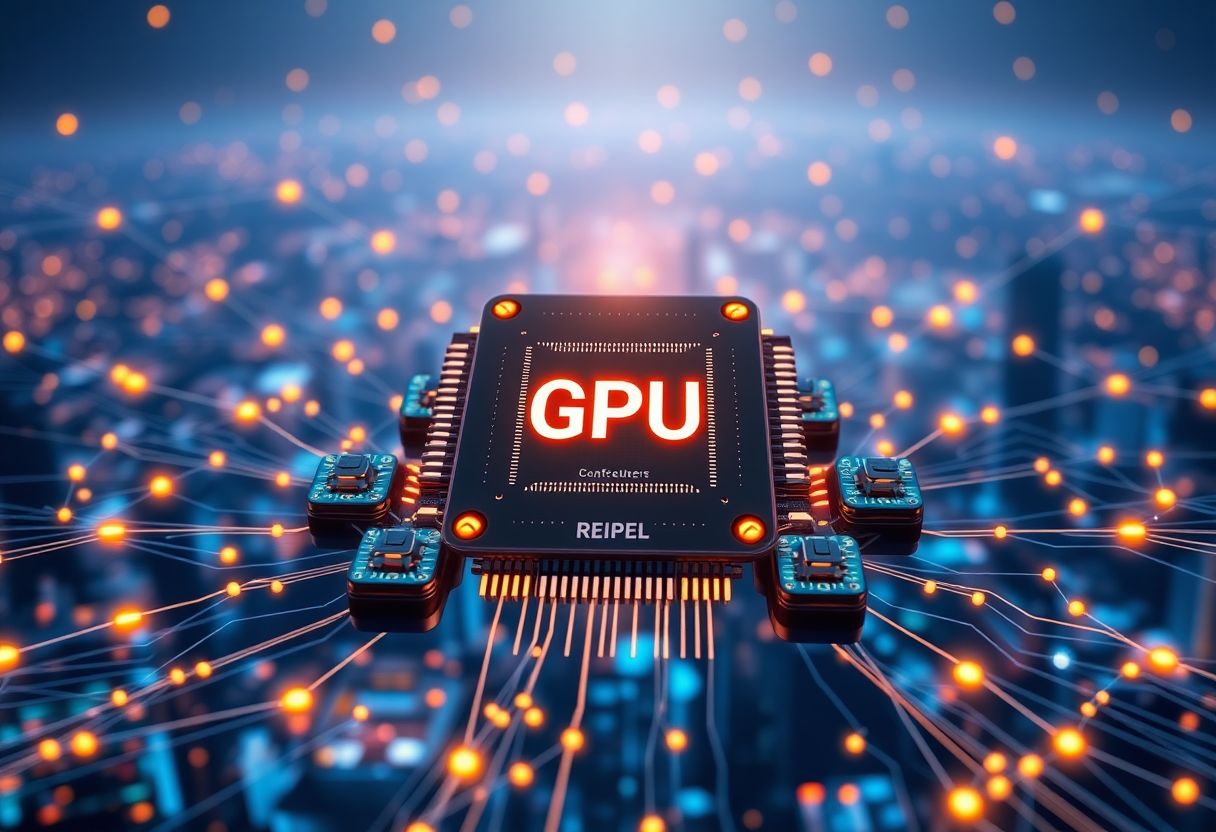
Render Climbs 12% as Decentralized GPU Network Posts $201M in Daily Volume
Render (RNDR) climbed 12.3% in the 24 hours to May 26, reaching $2.22 and posting $201.8 million in daily trading volume. The gain put Render among the strongest performers in the top-100 by market cap.
The move came as AI-compute narratives continued to attract capital across cryptocurrency markets, with decentralized GPU platforms drawing particular attention from investors positioning around real-world AI infrastructure demand.
Render’s Place in the AI Compute Stack
Render Network connects independent GPU owners with artists, developers, and AI researchers who need on-demand compute power. Node operators contribute idle GPU capacity in exchange for RNDR rewards, and buyers pay in RNDR for access to rendering and machine learning workloads.
The network runs on Solana (SOL) after migrating from Ethereum (ETH) in late 2023, a shift designed to lower transaction costs and increase throughput for high-frequency compute jobs.
The network’s market cap sits at roughly $1.15 billion, placing it at rank 63 globally. That valuation reflects investor appetite for tokens tied to tangible compute infrastructure rather than purely speculative narratives.
Render processed both 3D rendering jobs and AI model inference tasks through its peer-to-peer marketplace, though the network does not publish real-time job-count data publicly.
The 12% move on Monday puts RNDR’s 24-hour gain ahead of the broader market. Bitcoin (BTC) traded near $77,000 with minimal movement over the same period, and most major assets held in a tight range as macro caution around geopolitical uncertainty kept risk appetite subdued.
Also Read: ONDO Pulls Back but Holds $220M in Daily Volume as RWA Demand Builds
Why GPU Compute Tokens Keep Attracting Buyers
The thesis behind RNDR and similar tokens rests on a specific structural bet. Demand for GPU compute has grown sharply with the expansion of large language models, image generation tools, and real-time AI inference.
Centralized cloud providers including Amazon Web Services, Microsoft Azure, and Google Cloud charge premium rates for GPU-enabled instances. Decentralized alternatives promise lower cost by aggregating underused consumer and data-center hardware.
That narrative has drawn capital repeatedly since late 2023.
Render’s peak in early 2024 came as AI spending accelerated across the tech sector, and the token has traded with correlation to broader AI sentiment rather than to cryptocurrency market cycles alone. When large-cap tech stocks rally on AI earnings, RNDR typically follows.
When macro conditions tighten and risk assets pull back broadly, RNDR tends to underperform the crypto average.
The Render Network Foundation, which stewards the protocol, has partnered with AI research teams and media production studios to expand the range of workloads processed on-chain. Those partnerships have helped distinguish Render from purely speculative compute tokens that lack active job pipelines.
Also Read: Dave Ramsey Tells Caller She Bears Responsibility After Husband Hid $4.5M in Debt
The Broader Token Picture This Session
Render was not the only AI-adjacent token moving on May 26. Marlin (POND), a decentralized compute and networking protocol ranked 860th by market cap, posted a near 90% gain over 24 hours with $38.5 million in volume.
Marlin operates as a compute layer for confidential AI inference, allowing model operators to run workloads inside trusted execution environments without exposing model weights. The scale of the move suggests thin liquidity amplified directional momentum rather than a fundamental catalyst, though the protocol has attracted developer interest around private AI computation.
Bonk (BONK), the Solana (SOL)-based meme token, trended on CoinGecko with a market cap above $524 million, though its 24-hour change was marginally negative at roughly 1.4% down in dollar terms.
That Bonk (BONK) appeared in trending lists alongside Render and Marlin illustrates how the Solana ecosystem continues to surface across both speculative and infrastructure-focused narratives simultaneously.
The NFT index tracked by CoinGecko rose 33.3% as a category, and Game Studio tokens added 26.2%, suggesting that the May 26 session carried broader risk-on appetite for alternative-asset verticals inside cryptocurrency markets.
Also Read: Fixed-Rate Mortgages Are Getting More Expensive, And Interest Isn’t Why
What to Watch for Render
The key variable for RNDR over the next several weeks is whether AI spending data from major cloud providers continues to surprise to the upside. Earnings from hyperscalers in the coming quarter will either reinforce or undercut the GPU scarcity narrative that drives Render’s investment case.
If centralized cloud capacity expands faster than demand grows, the pricing advantage for decentralized alternatives narrows.
On the protocol side, Render Network’s ability to attract AI inference workloads at scale remains unproven relative to its rendering business. The migration to Solana improved cost structure, but the network still competes against better-capitalized rivals including Bittensor (TAO) and Filecoin (FIL), both of which have made aggressive bids for AI compute use cases.
A sustained move above $2.50 for RNDR would bring the token back into a range last visited during the February 2025 AI-token rotation. Failure to hold $2.00 support on any broader market pullback would likely see volume retreat sharply, given that much of today’s activity appears momentum-driven rather than anchored in new fundamental disclosures.
Read Next: Pudgy Penguins Rides NFT Index Surge as PENGU Holds Top-100