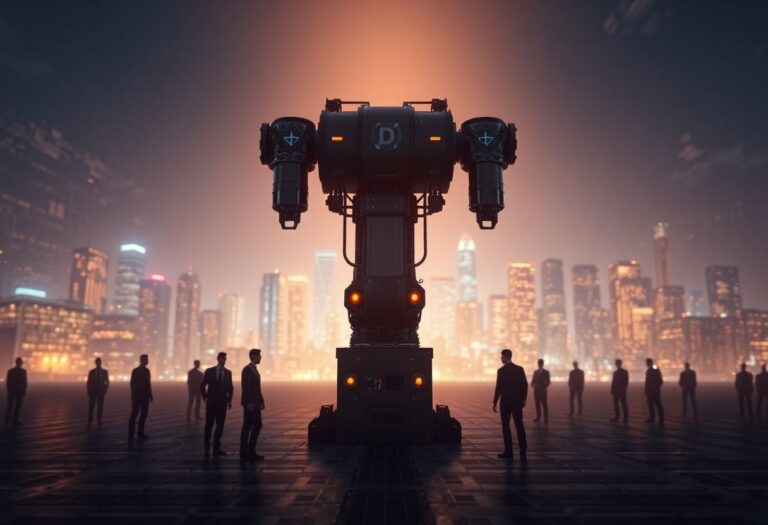
Elon Musk Predicts Humanoid Robots Will Outnumber Humans by Up to Tenfold
Benzinga reported Saturday that Tesla and SpaceX chief Elon Musk forecasts a world where humanoid robots outnumber humans by as much as tenfold. The remarks, drawn from Musk’s appearance at Y Combinator’s AI Startup School, underscore how aggressively he frames the automation era ahead.
Musk’s Vision of Humanoid Robots Outnumber Humans
Musk estimated that humanoid robots could outnumber the global human population by five to ten times. That projection is not framed as speculation. He treats it as a trajectory already in motion. Labor, under that model, would no longer scale with population. It would scale with deployment capacity instead. Entire sectors built on repetitive physical work, logistics, and manufacturing would face the earliest and most severe disruption. From there, the ripple effects would extend outward to industries not traditionally considered vulnerable to automation.
Tesla’s own humanoid robot program sits squarely inside this vision. The company’s stated ambition is not to produce novelty machines. It is to build at industrial scale.
Also Read: AI Startup Funding Surges as Investors Chase the Next Platform Shift
The Energy Framework Behind the Forecast
Musk grounded his long-range outlook in the Kardashev scale, a scientific framework ranking civilizations by their energy consumption. He argued that humanity currently captures only one to two percent of Earth’s available energy output. A Type 1 civilization on that scale would harness all of a planet’s energy. Type 2 would command the full output of a star, potentially a trillion times Earth’s capacity. Type 3 extends that to an entire galaxy. By that measure, Musk suggested, the technological transformation now beginning is still in its earliest moments.
More energy, in his framing, means more machines. More machines mean compounding output divorced from human headcount.
Also Read: What the AI Investment Wave Means for Labor Markets in 2026
Background: Automation Fears Have Grown With Each Leap in AI
Concern over machine-driven job displacement is not new. Economists debated it through the industrial revolution and again during the rise of factory robotics in the twentieth century. What has shifted is the speed and breadth of the current wave. Large language models and increasingly capable physical robots are converging faster than prior technological transitions. Policy and workforce planning have struggled to keep pace. Musk’s projections, however outsized, reflect a genuine acceleration that labour economists and governments are actively grappling with.
What Investors and Workers Are Watching
For markets, the practical question is which industries capture value from this shift and which absorb the disruption. Robotics, energy infrastructure, and AI oversight roles are broadly seen as growth areas. Roles tied to routine physical tasks face the clearest near-term pressure. The hundred-year horizon Musk invokes may feel abstract. The five-to-ten-year implications are considerably more immediate.
Read Next: Nvidia’s AI Chip Dominance Faces First Real Test as Rivals Scale Up